
The homes we loved ten years ago don't have to be the homes we'd design today. As our tastes evolve, there's something wonderful about finding new ways to layer, refine, and reimagine the spaces we already love.
There's something about living in a home for ten or fifteen years that gives you plenty of time to reconsider some of your original design decisions. The kitchen cabinets you absolutely loved when you installed them. The furniture you spent months choosing. The architectural details that seemed perfect at the time but that you'd probably approach differently today. None of these things is necessarily wrong, and most are still perfectly functional. But that doesn't mean you'd make the same choices again.
I've been thinking about this a lot lately as we renovate our lake house, which we purchased in 2015. When we originally renovated it, we leaned toward a fairly modern, Scandinavian-inspired design, with clean lines, glossy white kitchen cabinets, open shelving, and simple architectural details. It was exactly what we wanted at the time.
Fast-forward eleven years, and my tastes have changed. I still love clean design, but I'm drawn to warmer materials, more texture, and a softer, more relaxed beach house aesthetic. There are also things about the layout and outdoor spaces that we've realized could function better.
Does that mean we made the wrong decisions the first time? Not at all. We designed a lake house that reflected our tastes, needs, and budget at the time, and we loved it. But eleven years later, our style has evolved, and if we were designing it from scratch today, we'd undoubtedly make some different choices. That doesn't mean we need to start over. It simply means finding ways to update and refine what we already have, keeping the things we still love and changing the ones that no longer feel quite right. After all, if our tastes and lifestyles continue to evolve, shouldn't our homes be allowed to evolve with us?
When a Necessary Repair Becomes an Opportunity
We hadn't planned to renovate the lake house this year. But at the beginning of summer, while we had guests staying there, water started coming through a window. After bringing in a contractor, we discovered concerns about water intrusion behind some of the exterior siding, which meant removing sections of siding and addressing the underlying problems.
Not exactly the summer project we'd envisioned.
But once we knew we'd be doing some work to the exterior, we started reconsidering some of the design details that had bothered us for years.
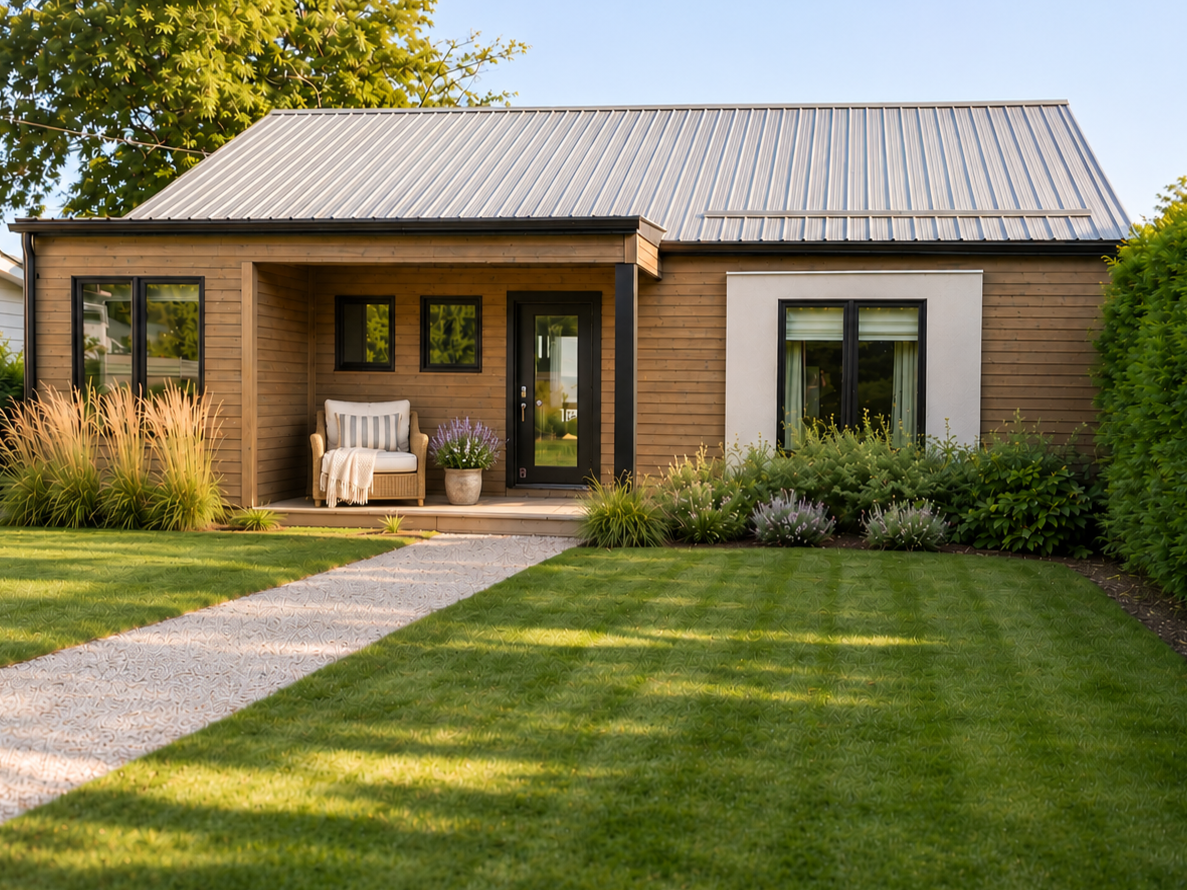
The front porch was a good example. Its roofline had never looked quite right to us, and over time we'd found ourselves wanting more natural timber detailing and architectural character. We loved the simplicity of the original design, but we'd started wanting something with a little more warmth and dimension.
I recently watched Shea McGee's home remodel reveal, and something about her approach really resonated with me. She talked about continuing to layer texture and detail into a home, even years after being originally designed. I love that idea of adding rather than necessarily subtracting, and of recognizing that a home doesn't have to be considered finished simply because the original renovation is complete.
That's very much how I approach design. I'm not particularly attached to a decision just because it's already on a set of plans. Sometimes you need to see something taking shape before you can decide whether it feels right, and sometimes you need to live with it for a while. A detail that looks perfect on paper doesn't always feel quite right once it's built, and I think it's important to leave room to make those decisions as a project progresses.
With our lake house, we're changing the porch roofline, adding exposed timber beams and rafters, and introducing an architectural awning over another front window. We're keeping the same Maibec siding because we still love it, and it ties in beautifully with our bunkie. Rather than redesigning the exterior entirely, we're adding some of the warmth, dimension, and architectural detail that we've come to appreciate more over the years.
And I think that's an important distinction when considering a renovation. You don't necessarily have to start over to make a home feel different. Sometimes it's about building on what's already there.
What Looks Beautiful Isn't Always What Works Best
Some of the changes we're making have less to do with aesthetics and more to do with what we've learned from actually living in the space.
Take our gravel pathways. When we originally landscaped the property, we used gravel along the front and side of the lake house and around the fire pit. I loved the look. It felt relaxed, rustic, and perfectly suited to a lakefront property.
What I didn't love was finding little stones constantly tracked into the lake house and bunkie. After years of sweeping them up, the charm had worn off a little.
We're now reworking some of those pathways and changing the approach to the front entrance. We're also making the front yard feel more private and creating a better connection between the lake house and bunkie.
The kitchen is another example. Eleven years ago, I loved the look of open shelving instead of upper cabinets. But after living with it for years, I've come to appreciate the practicality of closed cabinetry. I'd love more storage, and I'd much rather have dishes and glassware tucked away behind cabinet doors than sitting out collecting dust. Open shelving may look beautiful, but I've realized it's not necessarily the most practical choice for us.
Fortunately, we installed an IKEA kitchen during the original renovation, which means we can change the cabinet fronts, add upper cabinets, and update the hardware without replacing the entire kitchen. I love that we're able to give the space a completely different feel while keeping much of what we already have.
These are the kinds of things you can't always anticipate when you're designing a home. You make the best decisions you can at the time, but it's often only after living with them for years that you really understand what works for you. And I think there's something satisfying about being able to take those lessons and make a space better, rather than feeling that you have to live with every original decision forever.
Deciding What's Worth Changing
Of course, just because I'd like to change something doesn't mean it automatically makes sense to spend the money.
My husband and I both love design projects, and we can come up with a fairly ambitious list of improvements without much effort. The harder part is deciding which ones are worth pursuing.
With the lake house, we're constantly balancing what we'd love to do with what makes financial sense. It's a place our family spends a lot of time, but it's also a vacation rental, so durability, maintenance, and the return on our investment all factor into our decisions.
There are pieces of furniture I'd happily buy for our primary home that I wouldn't necessarily put in a rental property. And while I'd love a beautiful custom kitchen, I don't think we need one to achieve the look we're after.
We're also discovering, as we have during previous renovations, that small changes have a way of becoming bigger ones. Enlarging a bathroom by borrowing a little space from the covered porch sounded straightforward enough. But that meant adjusting the porch dimensions, which eventually led to moving a nearby window approximately five inches.
Five inches doesn't sound like much until you start considering everything involved in moving it.
And this is another part of renovating that I find both challenging and interesting. You can make all sorts of decisions during the planning stage, but once work begins, you sometimes discover that something needs to change. One adjustment affects another, and suddenly you're reconsidering details you thought were already settled. I've learned that it's worth being flexible, even when it means revisiting the original plan.
Ultimately, I think it's about being intentional with the changes you make. Some improvements make a space more functional. Others make it more beautiful. And the best ones often accomplish both.
A Home Is Never Really Finished
I think there's sometimes an expectation that once you've renovated or decorated a home, you're finished. You've made your choices, spent the money, and now you should be happy with everything for as long as it lasts.
I've never really looked at it that way. I love decorating and designing spaces, and I get an enormous amount of enjoyment from living in a home that feels comfortable and reflects my style. I don't think something needs to be broken or completely worn out before I'm allowed to reconsider it. And I like the idea that good design isn't necessarily about getting every detail perfect the first time. Sometimes it's about continuing to layer, refine, and improve a space as you discover what works and what doesn't.
Our lake house renovation wasn't something we'd planned to take on this year, and the water damage certainly wasn't a welcome surprise. But it's given us an opportunity to make changes we've been thinking about for a long time. I'm particularly excited about the architectural details we're adding to the exterior, which I think will give the lake house a warmth and character that better reflects our style today, while retaining much of what we loved about the original design.
I suspect that ten years from now, there will be other things I'd do differently. That's part of what I love about design. There's always something new to try, something to improve, or a detail worth reconsidering. And knowing me, I'll probably have another list of ideas long before then.